| DeWitt Hospital and Nursing Home is a not-for-profit hospital located in DeWitt, Arkansas. DeWitt Hospital and Nursing Home is an Equal Opportunity Employer |
| Virtual Colonoscopy |
All of our images are performed using digital equipment and
technology. All of our technologists in the radiology department are
state and nationally licensed and accredited. Our staff will be more than
happy to assist you with any of your imaging needs. Not all exams
require an appointment. If you have any questions about the
procedures that we offer or would like to schedule an appointment,
please contact the DeWitt Hospital at 870-946-3571 or to contact the
radiology department directly, call 870-233-2206.
What is Virtual Colonoscopy?
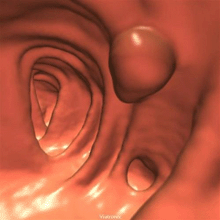
Virtual Colonoscopy is a new method that allows doctors to look at the
large bowel (colon) to detect polyps and cancers. Polyps are small
growths in the colon that may become cancerous if they are not
removed. Virtual colonoscopy is a recently developed technique that
uses a CT scanner and a 3-D virtual reality computer to look inside the
body without having to insert a long tube (Conventional Colonoscopy)
into the colon or without having to fill the colon with liquid barium
(Barium Enema.) Research has shown that Virtual Colonoscopy is better
able to see polyps than Barium Enema and is nearly as accurate as
Conventional Colonoscopy. In addition, most patients report that the
VIrtual Colonoscopy technique is more comfortable than either the
Barium Enema or Conventional Colonoscopy.
What can I expect during this procedure?
VC takes place in the radiology department of a hospital or medical
center. The exam takes about 10-15 minutes and does not require
sedatives. During the procedure:
stomach. A board certified radiologist evaluates the results to identify
any abnormalities.
technology. All of our technologists in the radiology department are
state and nationally licensed and accredited. Our staff will be more than
happy to assist you with any of your imaging needs. Not all exams
require an appointment. If you have any questions about the
procedures that we offer or would like to schedule an appointment,
please contact the DeWitt Hospital at 870-946-3571 or to contact the
radiology department directly, call 870-233-2206.
What is Virtual Colonoscopy?
Virtual Colonoscopy is a new method that allows doctors to look at the
large bowel (colon) to detect polyps and cancers. Polyps are small
growths in the colon that may become cancerous if they are not
removed. Virtual colonoscopy is a recently developed technique that
uses a CT scanner and a 3-D virtual reality computer to look inside the
body without having to insert a long tube (Conventional Colonoscopy)
into the colon or without having to fill the colon with liquid barium
(Barium Enema.) Research has shown that Virtual Colonoscopy is better
able to see polyps than Barium Enema and is nearly as accurate as
Conventional Colonoscopy. In addition, most patients report that the
VIrtual Colonoscopy technique is more comfortable than either the
Barium Enema or Conventional Colonoscopy.
What can I expect during this procedure?
VC takes place in the radiology department of a hospital or medical
center. The exam takes about 10-15 minutes and does not require
sedatives. During the procedure:
- You will be asked to lie on your back on a table.
- A thin tube will be inserted into your rectum, and air will be
pumped through the tube to inflate the colon for better viewing. - The table moves through the scanner to produce a series of 2-D
cross-sections along the length of the colon. A computer program
puts these images together to create a 3-D picture that can be
viewed on the video screen. - You will be asked to hold your breath during the scan to avoid
distortion on the images.
stomach. A board certified radiologist evaluates the results to identify
any abnormalities.